Introduction
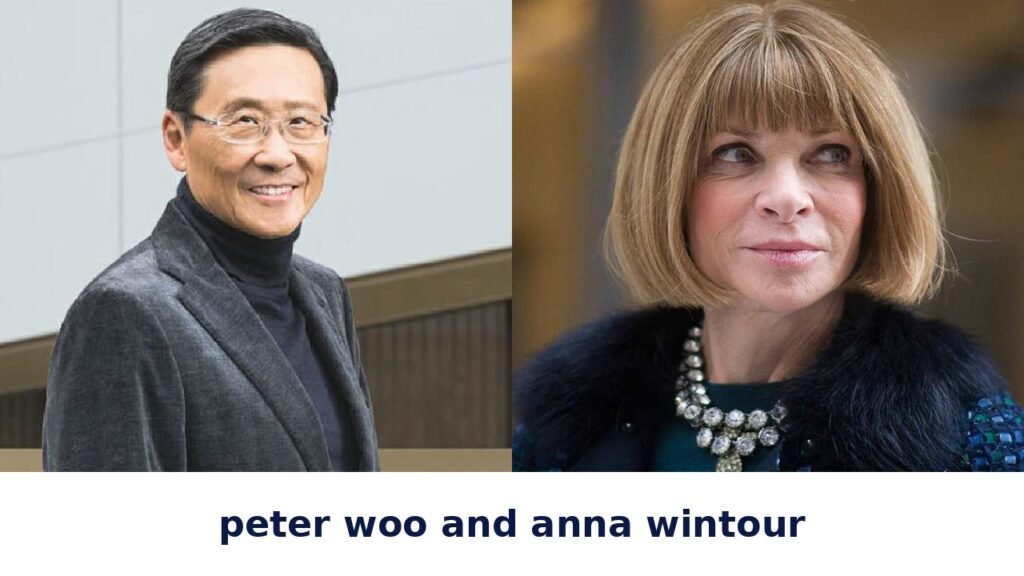
peter woo and anna wintour is a name pairing that joins two people who built power in completely different worlds, one in the property towers and shopping malls of Hong Kong and the other in the glossy pages and front rows of international fashion, and the first question most readers ask is what could possibly connect them. One is a Hong Kong billionaire who turned a family shipping fortune into one of Asia’s great property empires, while the other is a London-born editor who turned American Vogue into a cultural force that reached far past fashion. Yet a careful look at the public record shows that no verified deal, meeting, board seat or working partnership joins them, and this guide says so plainly rather than inventing a shared history.
This guide gives both people a full and fair account, using only facts that can be checked in public sources, and it answers the connection question honestly at the end. Readers who want a peter woo biography will find the rise of a Shanghai-born student who married into a shipping dynasty and then rebuilt it as a property group, and readers who want an anna wintour biography will find the story of a school leaver who climbed from a London boutique to the top of Condé Nast. Readers who follow business leader profiles will recognise both stories as classic examples of how lasting influence is built, one deal and one decision at a time, over decades rather than in a single dramatic moment.
Contents
peter woo and anna wintour: The Hong Kong Property Builder
Peter Woo Kwong-ching was born on September 5, 1946, in Shanghai, China, with ancestral roots in Ningbo, Zhejiang, and his family moved to Hong Kong in 1949, when he was still a small child. He was educated at St Stephen’s College in Stanley, Hong Kong, and then travelled to the United States, where he earned a bachelor’s degree from the University of Cincinnati, majoring in physics and mathematics, and served as senior class president while also joining the Delta Tau Delta fraternity. He later earned an MBA from Columbia Business School in New York, a combination of hard science and business training that shaped the way he later judged risk, since he learned to test a deal with numbers first and to trust instinct only after the figures had been checked.
After graduating, Woo worked at Chase Manhattan Bank in New York and Hong Kong, starting in 1972, and it was there that he met Bessie Pao, the daughter of shipping magnate Yue-kong Pao, whom he married in 1973. In 1975 he joined the family business, and when Pao retired in 1986, Woo took charge of the property side of the empire, becoming chairman of Wheelock and Company Limited and The Wharf (Holdings) Limited. The peter woo wheelock story therefore begins with marriage and family duty rather than with a start-up, yet Woo made the role his own, pushing the group past shipping and into property development, retail, telecommunications, ports and hotels across Hong Kong, mainland China and Singapore.
Under Woo, the Wharf group built and held some of the most famous commercial properties in Hong Kong, led by Harbour City on the Kowloon waterfront and Times Square in Causeway Bay, two vast retail and office complexes that anchor whole shopping districts. The group also ran other businesses that readers may know by name, including i-Cable Communications, Modern Terminals and Marco Polo Hotels, while Woo privately held the luxury retail group Lane Crawford Joyce Group, which owns the Lane Crawford department stores and the fashion house Joyce. That mix of landmark property and luxury retail gave Woo a footprint in daily life that few Hong Kong tycoons could match, since millions of shoppers walk through his buildings and stores without ever knowing his name.
peter woo and anna wintour: From Shanghai to the Top of Wheelock
The peter woo hong kong story also includes a serious public life, since Woo held a string of senior civic posts that placed him at the centre of the city’s institutions. He chaired the council of Hong Kong Polytechnic University from 1993 to 1997, chaired the Hong Kong Hospital Authority from 1995 to 2000, overseeing dozens of public hospitals and tens of thousands of staff, and chaired the Hong Kong Trade Development Council from 2000 to 2007, a body with offices around the world. He also sat on the Standing Committee of the Chinese People’s Political Consultative Conference, and the Hong Kong government named him a Justice of the Peace in 1993, awarded him the Gold Bauhinia Star in 1998 and the Grand Bauhinia Medal in 2012, the city’s highest honour.
Woo even tried for the top political job in Hong Kong, standing in the first Chief Executive election in 1996, just before the handover from British rule, alongside Yang Ti-liang and Tung Chee-hwa, and Tung won the contest. The defeat did not slow his business career, and he stayed in charge of Wheelock and Wharf until May 19, 2015, when he retired as chairman and his son Douglas Woo succeeded him. Wheelock was later taken private in 2020 and is now chaired by Douglas, while Woo’s daughter Jennifer Woo runs the Lane Crawford Joyce retail group, so the family business now spans a second generation in both property and luxury retail.
Fortune figures for Woo move with markets and with the way each rich list counts private assets, so readers should treat any single number as a snapshot rather than a fixed fact. Wikipedia, citing Forbes, put his net worth at about 14 billion dollars in April 2021, while a later Forbes-based report ranked him sixth among the richest people in Hong Kong with an estimated net worth of about 14.6 billion dollars. The exact figure matters less than the shape of the fortune, which rests on prime Hong Kong property, a private luxury retail group and a family holding structure that keeps control firmly inside the Woo and Pao families, and that structure is the reason the group survived handovers, recessions and market crashes without losing its core assets.
peter woo and anna wintour: The London Editor Who Remade Vogue
Anna Wintour was born on November 3, 1949, in Hampstead, London, the daughter of Charles Wintour, editor of the Evening Standard from 1959 to 1980, and Eleanor Trego Baker, known as Nonie, and she grew up in a house where newspapers and journalism set the rhythm of daily life. She attended North London Collegiate School and Queen’s College, London, and left school at sixteen, a decision that would have closed most careers but opened hers, since she went straight into fashion, working first at Biba, the cult London boutique of the swinging sixties, and then starting a trainee programme at Harrods, which she left before finishing it. In 1970 she became an editorial assistant at Harper’s and Queen, where she learned to build photo shoots with trendsetting photographers and to argue for images that broke the rules of the day.
Wintour moved to New York in 1975 and worked as a junior fashion editor at Harper’s Bazaar, then at Viva, Savvy and New York magazine, building a reputation for a sharp eye and a sharper tongue, and in 1983 she joined American Vogue as its first creative director. In 1985 she returned to London as editor-in-chief of British Vogue, holding that post for two years, and after a brief spell at House and Garden she took over American Vogue as editor-in-chief in 1988, succeeding Grace Mirabella. The anna wintour vogue era that followed lasted thirty seven years, one of the longest reigns in magazine history, and it changed what a fashion magazine could be, since Wintour mixed high couture with celebrity, politics and popular culture on the same pages.
Her first cover set the tone at once, since the November 1988 issue showed model Michaela Bercu in a pair of Guess jeans with a Christian Lacroix jacket, the first time jeans had ever appeared on the cover of Vogue, and the image announced that the magazine would no longer live only in studios and salons. Celebrity covers soon became the norm under Wintour, with figures from film, music, sport and politics given the same grand treatment once reserved for models, and the September issue grew into the biggest and most watched edition of the fashion year. Readers who follow fashion industry profiles will know that few editors have ever held such sway over designers, photographers and advertisers at once, since a Wintour cover could lift a young designer into the spotlight and a cold shoulder could leave a whole collection struggling for attention.
peter woo and anna wintour: The Met Gala and the Power of the Front Row
Past the magazine pages, Wintour’s most public stage became the Met Gala, the annual fundraiser for the Costume Institute at the Metropolitan Museum of Art in New York, which she took charge of in the 1990s and turned from an elite society dinner into a global media event watched by millions. As chair and gatekeeper of the guest list, she decided who sat at the tables, what theme each year would honour and which designers would dress the stars, and the red carpet arrivals became a fashion show in their own right, covered live around the world. The anna wintour met gala years also served a serious purpose, since the event raises large sums for the Costume Institute and gives the museum a yearly moment of mass attention, and Wintour also serves on the board of the Metropolitan Museum of Art, tying her editorial power to one of America’s great cultural institutions.
Wintour also used her position to back new talent, most visibly through the CFDA and Vogue Fashion Fund, which supports emerging designers with money, mentoring and industry access, and through her long habit of championing young names in the pages of Vogue before the rest of the industry caught up. Designers such as John Galliano, Marc Jacobs, Alexander McQueen and Tom Ford all gained from her early support, and her front-row presence at fashion weeks in New York, London, Milan and Paris became a signal in itself, since photographers and buyers read her reactions as a verdict on a collection. Her signature look helped that power, since the sharp bob she has worn since her teens, the dark sunglasses worn indoors and the calm, unsmiling front-row pose made her instantly recognisable in any crowd, and that image later fed popular culture in ways she could not control.
The most famous of those echoes is Miranda Priestly, the demanding editor played by Meryl Streep in the film of The Devil Wears Prada, a novel by Lauren Weisberger, who had worked as Wintour’s assistant, and Wintour is widely seen as the inspiration for the character, even though Weisberger has said the book is a work of fiction. Wintour herself answered the comparison with cool humour, telling the New York Times that she always enjoyed a great piece of fiction, and the film only deepened her fame, since audiences who had never opened Vogue now knew her silhouette and her reputation. Honours followed in real life as well, since she was named a Dame Commander of the Order of the British Empire in 2017, she was appointed to the Order of the Companions of Honour in 2023, and President Joe Biden awarded her the Presidential Medal of Freedom in January 2025.
peter woo and anna wintour: Wealth, Honours and Family
A peter woo biography and an anna wintour biography differ in almost every detail, yet both stories share a pattern of family, patience and control that is worth naming plainly. Woo married into a dynasty and then spent four decades protecting and growing it, raising three children, Douglas, Jennifer and Jacqueline, and handing the group to the next generation while keeping the family holding structure intact. Wintour built her power without a family fortune, raising two children through two marriages, first to child psychiatrist David Shaffer from 1984 to 1999 and then to investor Shelby Bryan from 2004 to 2020, while her brother Patrick Wintour became a senior journalist at The Guardian, so journalism ran through her whole family.
Their later years also show a similar instinct for orderly succession, since neither leader simply walked away and left chaos behind. Woo retired as chairman in 2015 with his son Douglas ready to take over, and Wheelock’s move to private ownership in 2020 completed a tidy handover of control. Wintour announced on June 26, 2025, that she would step down as editor-in-chief of American Vogue after thirty seven years, while staying on as Condé Nast’s global chief content officer and as Vogue’s global editorial director, and on September 2, 2025, Vogue named Chloe Malle, the editor of Vogue’s website, as the new head of editorial content for the American edition. Both handovers were planned in public, with successors already inside the house, which is a rare feat in businesses built so strongly around one person.
peter woo and anna wintour Facts at a Glance
| Point | Peter Woo | Anna Wintour |
|---|---|---|
| Born | September 5, 1946, Shanghai, China | November 3, 1949, Hampstead, London, England |
| Family background | Ancestral roots in Ningbo; moved to Hong Kong in 1949 | Daughter of Charles Wintour, editor of the Evening Standard |
| Education | St Stephen’s College; University of Cincinnati, physics and mathematics; MBA, Columbia Business School | North London Collegiate School; Queen’s College, London; left school at sixteen |
| Defining role | Chairman of Wheelock and Company and The Wharf (Holdings) until May 19, 2015 | Editor-in-chief of American Vogue, 1988 to 2025 |
| Signature work | Harbour City and Times Square in Hong Kong; Lane Crawford Joyce retail group | First jeans cover of Vogue in 1988; the Met Gala; the CFDA and Vogue Fashion Fund |
| Current role | Family holding figure; son Douglas chairs Wheelock | Global chief content officer, Condé Nast; global editorial director, Vogue |
| Honours | Justice of the Peace 1993; Gold Bauhinia Star 1998; Grand Bauhinia Medal 2012 | Dame Commander of the British Empire 2017; Companion of Honour 2023; Presidential Medal of Freedom 2025 |
| Family | Married Bessie Pao in 1973; three children, including Douglas and Jennifer Woo | Two children; brother Patrick Wintour is a Guardian journalist |
| Fortune snapshot | About 14 billion dollars, Forbes-based, April 2021; about 14.6 billion dollars on a later Forbes Hong Kong list | Salary and wealth figures vary by source and are not used here as a headline fact |
| Verified link to the other person | None found in the public record | None found in the public record |
The table above gathers the core of peter woo and anna wintour into one place, and its most useful row may be the last one, since it stops a reader from assuming a partnership that the record does not support. Woo’s fortune rests on property and retail, Wintour’s power rests on editorial judgment and cultural gatekeeping, and the two kinds of power rarely meet in the same room, even though both shape what wealthy people buy, wear and admire. A reader who keeps that distinction in mind will read the pairing as a study in contrast rather than as a hidden alliance, which is the honest way to read it.
peter woo and anna wintour: Is There a Verified Connection?
The direct answer is no, because no verified record shows a shared deal, a shared company, a shared board, an endorsement or a documented meeting linking peter woo and anna wintour, and readers should treat any page that claims such a link without naming a source as speculation rather than fact. Woo’s world was Hong Kong property, shipping family holdings, civic posts and luxury retail in Greater China, while Wintour’s world was London and New York magazine offices, Condé Nast boardrooms and the Met Gala red carpet, and their paths run through different cities, industries and institutions. No company filing, deal announcement or reputable news report found during research for this guide places their names side by side in any working capacity, and the peter woo and anna wintour connection question therefore has the same honest answer as many paired name searches, which is that the pairing reflects reader curiosity and the habit of search engines and biography sites to group prominent people, not a hidden partnership.
It is worth naming the one indirect thread that a careless reader could mistake for a link, since honesty demands that near misses be named as well as direct hits. Woo’s daughter Jennifer runs the Lane Crawford Joyce group, a luxury retail empire in Greater China that sells the very designer labels whose fate Wintour helps to shape from New York, so the Woo family retail business and the Wintour fashion world do touch the same industry from opposite ends. That overlap is real, yet it is not a link joining Peter Woo and Anna Wintour themselves, since no source shows the two of them dealing with each other, sitting on a board side by side or even attending the same event, and this guide records the overlap as context only, not as evidence of a relationship.
Conclusion
peter woo and anna wintour brings together a Hong Kong property builder who turned a family shipping fortune into a landmark real estate empire and a London-born editor who turned American Vogue into a global cultural force, two careers built on long patience, sharp judgment and control of their own fields but with no verified personal or professional link joining them. Readers who hold that distinction will take away the real value of the pairing, which is a clearer picture of two remarkable lives rather than a partnership that never existed.